Dual-Crew ePCR Remote Handoff and Chart Merge
How dual-crew ePCR remote handoff lets an engine crew send an open chart to the transport rig, and how Download and Merge joins split charts into one record.
A dual-crew ePCR remote handoff lets the first-due engine crew send their open, in-progress chart straight to the arriving transport crew's iPad, so nobody retypes vitals, meds or history. When two partners chart different parts of the same call on two iPads, Download and Merge pulls both into one record. One patient, one chart, no scraps of tape.
Why does retyping the engine's chart cause errors?
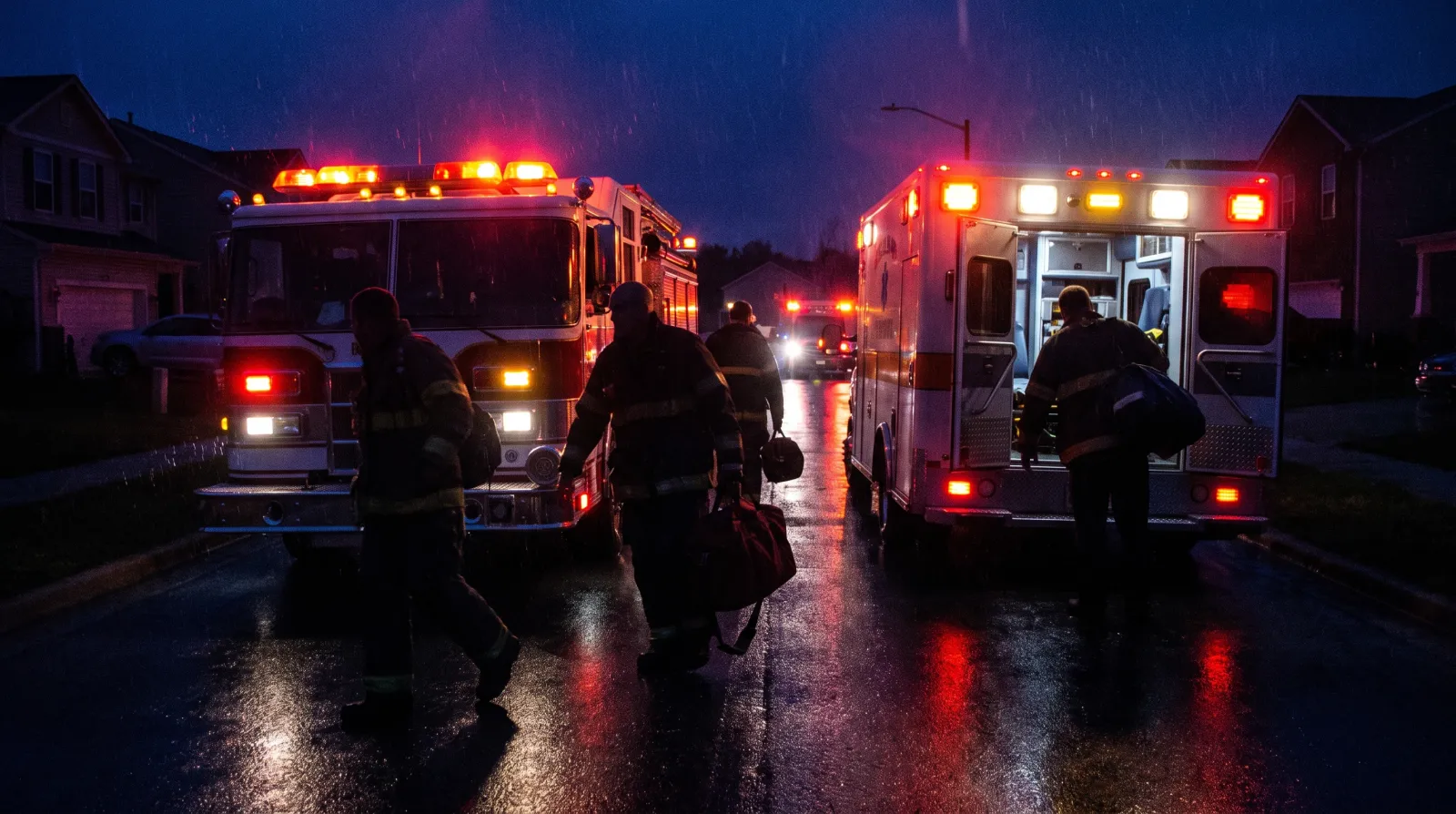
You know how this goes. The engine's been on scene for ten minutes with a sick patient. The ambulance backs in, the cot comes out, and report happens over a diesel idling three feet away. The engine medic's vitals are written on a strip of tape on their glove.
Then the transport medic opens a blank chart and starts over. Name, address, history, allergies, the first set of vitals, whatever the engine already gave. All of it gets typed again from memory and a smudged glove.
That's where mistakes slip in. Say the engine gave 4 mg of naloxone and the transport chart says 2 mg. Now the ED is working off the wrong number, and nobody notices until QA pulls the call.
The paperwork side hurts too. Two crews writing two charts for one patient means times that don't line up and narratives that disagree. Billing has to sort out which record is right, and the QA officer ends up chasing down crew statements weeks later.
How does Remote Handoff move a chart between rigs?
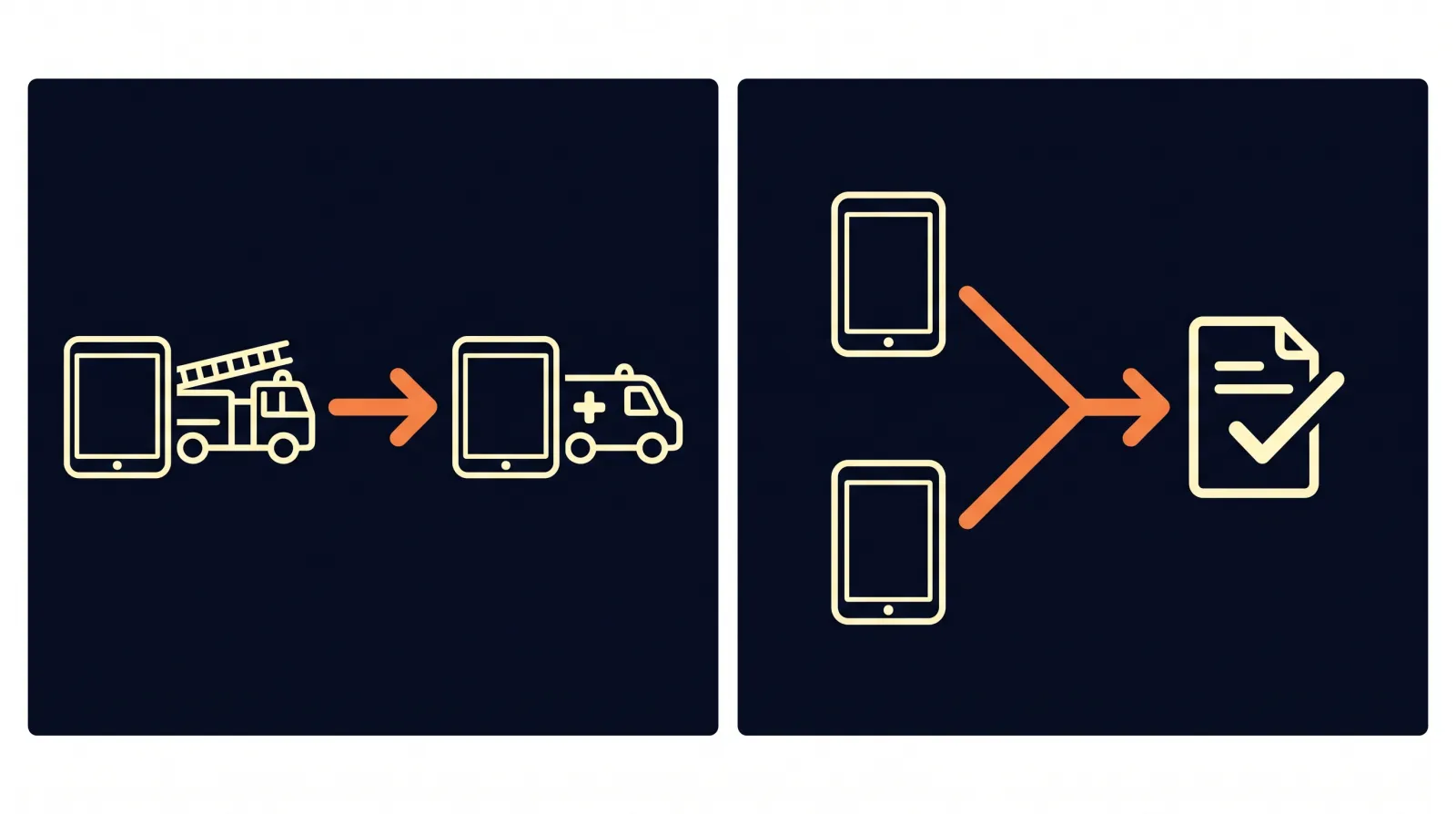
Mobile Medic's Remote Handoff sends an active, in-progress chart from one rig's iPad to another crew's iPad over the internet. The receiving crew opens the same chart and keeps going. It works whether the transport unit is pulling up nose to nose or still a few miles out.
Here's how it plays out. The engine crew gets on scene and starts care. The captain opens Medic Clipboard and logs the first vitals. The engine medic adds allergies, history and the oxygen they put on.
When the ambulance is close, the engine medic sends the chart. The transport crew picks it up on their own iPad, and everything the engine documented is already there. The ambulance medic keeps charting from where the fire crew stopped, instead of starting a new run.
The engine clears without writing a second chart, and the transport medic can keep their eyes on the patient instead of on a keyboard.
How does the transport crew pick up a sent chart?
Taking over a chart has to be quick. Nobody wants to dig through menus while they're loading a patient. In Mobile Medic, charts sent from other units show up on a receiving screen where the transport crew can find and open them.
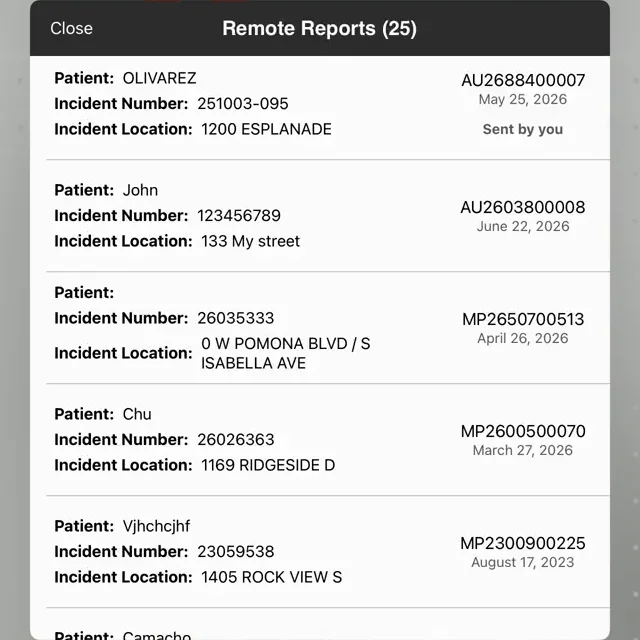
Each sent chart in the list shows the patient's last name, the incident number, the scene address and the date, so the transport medic can pick the right call and accept it. From there it's their chart. They add the IV, rhythm changes, repeat vitals and transport details like any other run.
What about a dead zone right after the handoff? Sending the chart needs a connection, but once it's on the receiving iPad, charting works with no signal at all. The chart saves on the device and syncs when the rig gets coverage again. Our post on offline-first ePCR architecture explains how that works in hospital basements and rural stretches.
How do partners split charting with Download and Merge?
On a bad call, one person can't manage the airway, push meds and type the chart all at once. Download and Merge lets partners split the documentation across two iPads and combine it afterward:
- One partner works at the patient's side: vitals, interventions and what's happening on the monitor
- The other gathers the paperwork side: demographics, insurance, home meds and history from family
- After the call, the transport crew downloads both records and merges them into a single patient chart
- The merge combines interventions, vital sets and demographics without overwriting notes that are already there
That last part matters. Nobody wants to find out at the end of a call that their partner's save wiped out twenty minutes of their own charting. If both partners typed into the exact same field, the merge keeps the entry that's already on the receiving iPad and only fills in fields that are blank. So the lead medic should give those shared fields a quick look before closing the chart.
Can one record cut duplicate charts and billing fights?
When two crews write separate charts for one patient, dispatch, billing and QA all have to untangle it later. Times don't match, care levels look different, and one call can turn into two claims that need to be reconciled by hand.
A shared chart helps cut that off at the source. With Remote Handoff, the engine's care and the transport crew's care live in one record instead of two. It's still worth a line in the narrative about which crew did what. Mobile Medic also flags possible duplicate charts when dispatch sends more than one rig to the same patient. On the office side, CAD reconciliation compares dispatch logs against finished charts to catch missing reports, duplicate runs and timing gaps.
| What you're comparing | Verbal report and paper scraps | Two separate charts | Remote Handoff and Merge |
|---|---|---|---|
| Getting the engine's data to transport | Retyped from memory and tape | Never transferred, written twice | Sent as an open chart between iPads |
| Medication doses and times | Easy to miscopy | Two charts can disagree | Carried over as the engine charted them |
| Billing and QA review | Engine care often missing | Two records to reconcile | One record with both crews' care |
| Crew workload | Rushed handoff on scene | Double charting after the call | Work split across partners, merged later |
Medical directors and QA get one chart to review instead of two. State reporting gets a single, consistent record for the patient instead of two that contradict each other.
What does a handoff look like on a real call?
Frequently asked questions
Can a fire department send charts to a private ambulance service?
Yes, if both agencies use Mobile Medic. When sending, the medic can pick another agency and a specific unit there, so a city engine can hand a chart to a private ambulance company's rig. Make sure the two agencies have their data-sharing agreements in place first.
What happens if both partners edit the same field?
Most of the time partners chart different things, like vitals on one iPad and demographics on the other, and the merge combines them without overwriting existing notes. If both entered something different in the same field, the merge keeps what's already on the receiving iPad and doesn't flag the difference, so the lead medic should check those fields before the chart is finished.
How is patient data protected during a handoff?
Charts travel through Mobile Medic's servers over an encrypted web connection, not an open tablet-to-tablet link. On the iPad, Mobile Medic uses Apple's built-in data protection for what's stored on the device.
What if the transport unit cancels before it arrives?
Then nothing gets sent. Handoff is optional, so the engine crew finishes and uploads its own chart, documenting the refusal or cancellation like any other call.
Does the first-due crew still get credit in NEMSIS?
NEMSIS has data elements for the responding agency, unit and crew. A handed-off chart doesn't label who entered what, so before it's finished, make sure the crew fields and narrative show the first-due crew's part the way your agency and state want it. If you're preparing for the next version of the standard, our NEMSIS 3.5.1 field prep guide covers what's changing.
Want to see a handoff in action?
The handoff shows up in the transport chapter of our night-shift story on the home page. Watch the chart move between rigs and see how it would fit your dual-response calls.